Showing posts with label Automover. Show all posts

Get set my vehicle for Interstate Car Transport

Thursday, April 19, 2012
Many car transport companies available in USA, there are certain elements you need to do way before you schedule your car for interstate car transport. But first, let's say about car transport. Transporting car is actually quite easy and very self-explanatory. A car transport company is a company of carriers that will store, ship, and transport your car for you to a new location. Car transporting companies can virtually ship your vehicle anywhere you want, from car transport Florida to auto transport California. This is ideal for corporations, military vehicles, and people that are moving from one location to another and simply don't want to drive their vehicles.
Interstate Car Transport
Planning your car for interstate car transport is no problem at all if you just adhere these easy rules:
First off, your car needs to be cleaned and cleared. Take it to the car wash (it probably needs it anyway), vacuum it out, and eliminate any big items like car seats. Well, these items can be placed around quite a bit during transport, and car transport companies would rather play it safe than have something happen to your car, like a cracked window from something heavy or hard. Besides, with something like a car seat, you're not driving in the car anyway! So pack it away in the moving truck. Next, if you are shipping a convertible, make sure the top is up and it's secured and locked. Also, if you have any rips or cracks in the material of the top; make sure you fix this beforehand if you are getting an open carrier. If it's seeing or seeing, this is going to get into the car and cause all types of issues.
You also need to eliminate any personalized items such as grill covers, LED lighting under the car, removable antennas, luggage racks, etc. Anything that isn't nailed down pretty much. Take it off, put it in your moving truck and that's that. This is basically just another safety issue, but it's also to keep the accessories from getting lost or broken. Please make sure your gas tank is less than a quarter way full. As with most other trucks and carriers, car transport companies are charged by weight when their vehicles pass through weighing stations. The less fuel everyone has in their cars and vehicles, the less it's going to cost for the carrier.
If you joined a really awesome interstate vehicle transport company, the business should have updates on the route available on its website when you sign up for an account. This way, you can see where the carrier is and how much longer it is going to be. When your car arrives at your new home, please be sure to do a once over on the car. If you find anything broken, missing, cracked, etc.; carry it to the interest of the car transport companies.

9 Ways To Lower Your Auto Insurance Costs

Wednesday, March 11, 2009
One of the best ways to keep your auto insurance costs down is to have a good driving record.
Listed below are other things you can do to lower your insurance costs.


1. Shop Around
Prices vary from company to company, so it pays to shop around. Get at least three price quotes. You can call companies directly or access information on the Internet. Your state insurance department may also provide comparisons of prices charged by major insurers.

You buy insurance to protect you financially and provide peace of mind. It's important to pick a company that is financially stable. Check the financial health of insurance companies and consult consumer magazines.

Get quotes from different types of insurance companies. Some sell through their own agents. These agencies have the same name as the insurance company. Some sell through independent agents who offer policies from several insurance companies. Others do not use agents. They sell directly to consumers over the phone or via the Internet.

Don't shop price alone. Ask friends and relatives for their recommendations. Contact your state insurance department to find out whether they provide information on consumer complaints by company. Pick an agent or company representative that takes the time to answer your questions. You can use the checklist on the back of this brochure to help you compare quotes from insurers and on the same coverage.

2. Before You Buy a Car, Compare Insurance Costs
Before you buy a new or used car, check into insurance costs. Car insurance premiums are based in part on the car’s sticker price, the cost to repair it, its overall safety record, and the likelihood of theft. Many insurers offer discounts for features that reduce the risk of injuries or theft. These include daytime running lights and anti-theft devices. To help you decide what car to buy, you can get information from the Insurance Institute for Highway Safety.

3. Ask for Higher Deductibles
Deductibles are what you pay before your insurance policy kicks in. By requesting higher deductibles, you can lower your costs substantially. For example, increasing your deductible from $200 to $500 could reduce your collision and comprehensive coverage cost by 15 to 30 percent. Going to a $1,000 deductible can save you 40 percent or more. Before choosing a higher deductible, be sure you have enough money set aside to pay it if you have a claim.

4. Reduce Coverage on Older Cars
Consider dropping collision and/or comprehensive coverages on older cars. If your car is worth less than 10 times the premium, purchasing the coverage may not be cost effective. Auto dealers and banks can tell you the worth of cars. Review your coverage at renewal time to make sure your insurance needs haven’t changed.

5. Buy your Homeowners and Auto Coverage from the Same Insurer
Many insurers will give you a break if you buy two or more types of insurance. You may also get a reduction if you have more than one vehicle insured with the same company. Some insurers reduce the rates for long-time customers. But it still makes sense to shop around! You may save money buying from different insurance companies, compared with a multi-policy discount.

6. Maintain a Good Credit Record
Establishing a solid credit history can cut your insurance costs. Insurers are increasingly using credit information to price auto insurance policies. To protect your credit standing, pay your bills on time, don't obtain more credit than you need and keep your credit balances as low as possible. Check your credit record on a regular basis and have any errors corrected promptly so that your record remains accurate.

7. Take Advantage of Low Mileage Discounts
Some companies offer discounts to motorists who drive a lower than average number of miles a year. Low mileage discounts can also apply to drivers who car pool to work.

8. Ask about Group Insurance
Some companies offer reductions to drivers who get insurance through a group plan from their employers, through professional, business and alumni groups, or other associations. Ask your employer and inquire with groups or clubs you are a member of to see if this is possible.

9. Seek Out Other Discounts
Companies offer discounts to policyholders who have not had any accidents or moving violations for a number of years. You may also get a discount if you take a defensive driving course. If there is a young driver on the policy who is a good student, has taken a drivers education course or is at a college out of the area without a car, you may also qualify for a lower rate.

When you comparison shop, inquire about discounts for the following:

[ ] $500 deductible
[ ] $1,000 deductible
[ ] More than 1 car
[ ] No Accidents in 3 Years
[ ] No Moving Violations in 3 Years
[ ] Driver Training Courses
[ ] Defensive Driving Courses
[ ] Anti-Theft Devices
[ ] Low Annual Mileage
[ ] Air Bags
[ ] Anti-Lock Brakes
[ ] Daytime Running Lights
[ ] Student Drivers with Good Grades
[ ] Auto and Homeowners Coverage with the Same Company
[ ] College Students away from Home
[ ] Long-Time Customer
[ ] Other Discounts

The key to savings is not the discounts, but the final price. A company that offers few discounts may still have a lower overall price.

These discounts listed may not be available in all states or from all insurance companies.

ARRIVE ALIVE, DON'T DRINK AND DRIVE

Sunday, March 1, 2009
The facts you need to know:
  • You are driving under the influence of alcohol when you have a concentration of over 0,08 gram per 100ml blood-alcohol level or 0,38 milligram per 1000 ml of breath-alcohol
  • The maximum penalty for drunk driving is R120,000 and/or six years imprisonment
  • A magistrate can suspend or permanently cancel your driver=s licence if you are convicted of drunken driving
  • You will have a criminal record if you are found guilty of driving under the influence
ALCOHOL IS NOT A MITIGATING FACTOR IN ANY ROAD
CRASH OR ANY COURT ACTION ARISING OUT OF ONE

DRINKING AND DRIVING IS A
CRIMINAL OFFENCE

LATEST!: Breathalyser Test results have been accepted by Attorney’s General as admissible evidence in court. This means that:
  • It will be easier for traffic officers to check drivers for drinking and driving as they will no longer need nurses at roadblocks or have to take drivers to hospital to draw a blood sample
  • If a driver is breathalysed and found to be over the legal limit, s/he can be taken off the road immediately and could be sentenced within hours. There are no court delays arising from the wait for blood test results
  • The introduction of the breathalyser in the UK led to a 300% increase in convictions in its first year of operation
ALCOHOL AFFECTS YOUR ABILITY TO DRIVE
Alcohol is water-soluble and is absorbed in the blood. More blood is supplied to the brain than other organs, with the result that alcohol impairs your brain functions within minutes.

At a breath-alcohol level of 0.38:
  • Reaction time doubles, muscle co-ordination diminishes and a driver is more likely to respond incorrectly to stimuli
  • Alcohol affects the forebrain by suppressing caution, carefulness, concentration, self criticism and self control
  • It is a mood changer, leading to a feeling of well-being and to recklessness, aggression and carelessness, all of which are highly likely to negatively affect judgement
  • Alcohol affects vision: Depth perception deteriorates, making it impossible to judge accurately how far away objects are. Eye muscles lose their precision and when both eyes can=t focus on the same object, vision becomes blurred or you see double.
  • Alcohol results in tunnel vision. At night pupils don=t adapt from darkness to light and a drunk driver will be dazzled by oncoming headlights much more severely than a sober driver. Alcohol also makes night blindness worse.
WHAT HAPPENS IF YOU ARE CAUGHT DRINKING AND DRIVING
  • If you are caught driving under the influence of alcohol, you do not have the option of paying a fine. You will be arrested on the spot
  • You will then be taken to a police station where you get booked and locked up in a cell until you are sober
  • After you have sobered up (which can take hours), you will be charged for driving under the influence of alcohol
  • If a blood test is being used as evidence, you may apply for bail in a magistrate’s office or court
  • If you cannot afford bail you will be locked up until the case is heard, usually about two months after being charged
  • If a breathalyser test is being used as evidence, you will appear in court the next weekday in some jurisdictions.
The higher your alcohol level goes,
the more likely you will crash

If your blood alcohol concentration is 0.08 you are four times more likely to crash than if you are sober. With a count of 0.12, your chances are 15 times more likely and at 0.16 your chances of crashing are 30 times more than if you're sober.

Car Ads: Reading Between the Lines

Wednesday, February 25, 2009
Many new car dealers advertise unusually low interest rates and other special promotions. Ads promising high trade-in allowances and free or low-cost options may help you shop, but finding the best deal requires careful comparisons.

Many factors determine whether a special offer provides genuine savings. The interest rate, for example, is only part of the car dealer’s financing package. Terms like the size of the downpayment also affect the total financing cost.

Questions About Low Interest Loans
A call or visit to a dealer should help clarify details about low interest loans. Consider asking these questions:
  • Will you be charged a higher price for the car to qualify for the low-rate financing? Would the price be lower if you paid cash, or supplied your own financing from your bank or credit union?
  • Does the financing require a larger-than-usual downpayment? Perhaps 25 or 30 percent?
  • Are there limits on the length of the loan? Are you required to repay the loan in a condensed period of time, say 24 or 36 months?
  • Is there a significant balloon payment —possibly several thousand dollars — due at the end of the loan?
  • Do you have to buy special or extra merchandise or services such as rustproofing, an extended warranty, or a service contract to qualify for a low-interest loan?
  • Is the financing available for a limited time only? Some merchants limit special deals to a few days or require that you take delivery by a certain date.
  • Does the low rate apply to all cars in stock or only to certain models?
  • Are you required to give the dealer the manufacturer’s rebate to qualify for financing?

Questions About Other Promotions
Other special promotions include high trade-in allowances and free or low-cost options. Some dealers promise to sell the car for a stated amount over the dealer’s invoice. Asking questions like these can help you determine whether special promotions offer genuine value.
  • Does the advertised trade-in allowance apply to all cars, regardless of their condition? Are there any deductions for high mileage, dents, or rust?
  • Does the larger trade-in allowance make the cost of the new car higher than it would be without the trade-in? You might be giving back the big trade-in allowance by paying more for the new car.
  • Is the dealer who offers a high trade-in allowance and free or low-cost options giving you a better price on the car than another dealer who doesn’t offer promotions?
  • Does the "dealer’s invoice" reflect the actual amount that the dealer pays the manufacturer? You can consult consumer or automotive publications for information about what the dealer pays.
  • Does the "dealer’s invoice" include the cost of options, such as rustproofing or waterproofing, that already have been added to the car? Is one dealer charging more for these options than others?
  • Does the dealer have cars in stock that have no expensive options? If not, will the dealer order one for you?
  • Are the special offers available if you order a car instead of buying one off the lot?
  • Can you take advantage of all special offers simultaneously?
You’re not limited to the financing options offered by a particular dealer. Before you commit to a deal, check to see what type of loan you can arrange with your bank or credit union.

Once you decide which dealer offers the car and financing you want, read the invoice and the installment contract carefully. Check to see that all the terms of the contract reflect the agreement you made with the dealer. If they don’t, get a written explanation before you sign. Careful shopping will help you decide what car, options, and financing are best for you.

The Low-Down on High Octane Gasoline

Friday, February 20, 2009
Are you tempted to buy a high octane gasoline for your car because you want to improve its performance? If so, take note: the recommended gasoline for most cars is regular octane. In fact, in most cases, using a higher octane gasoline than your owner's manual recommends offers absolutely no benefit. It won't make your car perform better, go faster, get better mileage or run cleaner. Your best bet: listen to your owner's manual.

The only time you might need to switch to a higher octane level is if your car engine knocks when you use the recommended fuel. This happens to a small percentage of cars.

Unless your engine is knocking, buying higher octane gasoline is a waste of money, too. Premium gas costs 15 to 20 cents per gallon more than regular. That can add up to $100 or more a year in extra costs. Studies indicate that altogether, drivers may be spending hundreds of millions of dollars each year for higher octane gas than they need.

What are octane ratings?
Octane ratings measure a gasoline's ability to resist engine knock, a rattling or pinging sound that results from premature ignition of the compressed fuel-air mixture in one or more cylinders. Most gas stations offer three octane grades: regular (usually 87 octane), mid-grade (usually 89 octane) and premium (usually 92 or 93). The ratings must be posted on bright yellow stickers on each gasoline pump.

What's the right octane level for your car?
Check your owner's manual to determine the right octane level for your car. Regular octane is recommended for most cars. However, some cars with high compression engines, like sports cars and certain luxury cars, need mid-grade or premium gasoline to prevent knock.

How can you tell if you're using the right octane level?
Listen to your car's engine. If it doesn't knock when you use the recommended octane, you're using the right grade of gasoline.

Will higher octane gasoline clean your engine better?
As a rule, high octane gasoline does not outperform regular octane in preventing engine deposits from forming, in removing them, or in cleaning your car's engine. In fact, the U.S. Environmental Protection Agency requires that all octane grades of all brands of gasoline contain engine cleaning detergent additives to protect against the build-up of harmful levels of engine deposits during the expected life of your car.

Should you ever switch to a higher octane gasoline?
A few car engines may knock or ping - even if you use the recommended octane. If this happens, try switching to the next highest octane grade. In many cases, switching to the mid-grade or premium-grade gasoline will eliminate the knock. If the knocking or pinging continues after one or two fill-ups, you may need a tune-up or some other repair. After that work is done, go back to the lowest octane grade at which your engine runs without knocking.

Is knocking harmful?
Occasional light knocking or pinging won't harm your engine, and doesn't indicate a need for higher octane. But don't ignore severe knocking. A heavy or persistent knock can lead to engine damage.

Is all "premium" or "regular" gasoline the same?
The octane rating of gasoline marked "premium" or "regular" is not consistent across the country. One state may require a minimum octane rating of 92 for all premium gasoline, while another may allow 90 octane to be called premium. To make sure you know what you're buying, check the octane rating on the yellow sticker on the gas pump instead of relying on the name "premium" or "regular."

HYPERTHERMIA (Heatstroke)

Thursday, February 19, 2009
Problem : Children die each year from heatstroke, after being left alone in a vehicle.

You live by your daily routine and it helps you get things done. Be extra careful, though, if you have to change any part of that routine. This is more likely to happen when you, or caregiver who helps with your children, forgets that a child is in the back seat. This can and does happen when you break a well-established routine.

Disasters happen quickly
At other times, you are on your way home and realize you need to stop in at the store and pick up one or two things for dinner. So, you leave your child unattended, thinking, "I'll just run into the store for a minute." Even cool temperatures in the 60s can cause the temperature to rise well above 110° Fahrenheit inside your car. The inside temperature can rise almost 20 degrees within the first 10 minutes.

Some children die in hot cars after climbing into an unlocked vehicle without an adults' knowledge. Once in the vehicle, they may become confused by the door opening mechanism or trapped in the trunk, and unable to get out before heatstroke occurs.

Prevention Tips :
  • Never leave a child unattended in a vehicle.
  • Do not let your children play in an unattended vehicle. Teach them that a vehicle is not a play area.
  • Never leave infants or children in a parked vehicle, even if the windows are partially open.
  • Make a habit of looking in the vehicle - front and back - before locking the door and walking away.
  • If you are dropping your child off at childcare, and normally it's your spouse or partner who drops them off, have your spouse or partner call you to make sure the drop went according to plan.
  • Ask your childcare provider to call you if your child does not show up for childcare.
  • Do things to remind yourself that a child is in the vehicle, such as
  • Writing yourself a note and putting the note where you will see it when you leave the vehicle;
  • Placing your purse, briefcase or something else you need in the back seat so that you will have to check the back seat when you leave the vehicle; or
  • Keeping an object in the car seat, such as a stuffed toy. When the child is buckled in, place the object where the driver will notice it when he or she is leaving the vehicle.
  • Always lock vehicle doors and trunks and keep keys out of children's reach. If a child is missing, check the vehicle first, including the trunk.
  • If you see a child alone in a hot vehicle, call the police. If they are in distress due to heat, get them out as quickly as possible. Cool the child rapidly. Call 911 or your local emergency number immediately.
What you need to know, now:
  • Vehicles heat up quickly - even with a window rolled down two inches, if the outside temperature is in the low 80s° Fahrenheit, the temperature inside a vehicle can reach deadly levels in only 10 minutes.
  • Children's bodies overheat easily, and infants and children under four years of age are among those at greatest risk for heat-related illness.
  • Children's bodies absorb more heat on a hot day than an adult. Also, children are less able to lower their body heat by sweating. When a body cannot sweat enough, the body temperature rises rapidly.
  • In fact, when left in a hot vehicle, a young child's body temperature may increase three to five times as fast an adult. High body temperatures can cause permanent injury or even death.
Dangers of extreme heat :
  • Symptoms of heatstroke : Warning signs vary but may include: red, hot, and moist or dry skin, no sweating, a strong rapid pulse or a slow weak pulse, a throbbing headache, dizziness, nausea, confusion, being grouchy, or acting strangely.
  • If you see a child alone in a hot vehicle, call the police. If they are in distress due to heat, get them out as quickly as possible. Cool the child rapidly.

Frequently asked Question about Smog Check Program

Tuesday, February 17, 2009
Q What are the environmental benefits of the Smog Check Program?
A The Smog Check Program has greatly reduced air pollution created by millions of cars in California. According to the California Air Resources Board, the program removes about 400 tons of smog-forming pollutants from California’s air every day.

Q Is my vehicle required to get a Smog Check?
A Your vehicle needs a Smog Check if it is more than six model years old and the model year is 1976 or newer. (This does not include diesel vehicles, motorcycles, electric and hybrid vehicles, and two-cylinder engine vehicles.)

Q How can I help my vehicle pass a Smog Check?
A Performing proper and regular vehicle maintenance according to your owner’s manual, and not tampering with the emissions control equipment are keys to passing Smog Check.

Q How often does my vehicle have to be tested?
A Your vehicle must be tested every other year. A Smog Check is also required if you sell your vehicle and it is more than four model years old. Some vehicles may require a Smog Check at a Test-Only or Gold Shield station.

Q What happens if my vehicle fails a Smog Check?
A In order to complete your registration, you will need to obtain the repairs necessary for it to pass its Smog Check retest. Before beginning repairs, find out if you are eligible for our Consumer Assistance Program (CAP).

Q What is a Test-Only station?
A Test-Only stations are licensed Smog Check stations that are only allowed to test cars. State law prohibits them from making repairs.

Q What is CAP and how do I qualify?
A The Consumer Assistance Program (CAP) provides financial assistance to repair or retire a vehicle that fails a Smog Check.

Repair Assistance — If your DMV renewal notice requires a Smog Check at a Test-Only or Gold Shield station, you may qualify for up to $500 in repair assistance once you pay the first $100 in repair costs. You may also qualify if your income is within certain levels, regardless of where you got your Smog Check. If you qualify based on income, a $20 co-pay is all that you need.

Vehicle retirement — If you feel your car is not worth repairing, the State may buy the car from you for $1,000 and have it scrapped at a local dismantler.

Q What is a Gold Shield station?
A Gold Shield stations are licensed Smog Check stations that meet certain performance criteria in order to test and repair all cars. They also provide repairs on vehicles that qualify for financial assistance under the Consumer Assistance Program (CAP).

Q How will I know if I need to take my car to a Test-Only or Gold Shield station?
A You will be notified on the registration renewal notice sent by the California Department of Motor Vehicles (DMV) if your vehicle must be inspected at a Test-Only or Gold Shield station.

Reducing greenhouse gas emissions

Sunday, February 15, 2009
For every litre of petrol used in a motor vehicle, 2.3 kilograms of carbon dioxide (CO2 ), a major greenhouse gas, is released from the exhaust. The Australian transport sector accounts for around 76 million tonnes of Australia's total net greenhouse gas emissions, representing 13.5 per cent of Australia's total emissions.

Emissions from different fuels

Fuels differ in the amount of carbon and energy they contain as well as other characteristics, with implications for fuel economy and greenhouse emissions. The table below lists the amount of CO2 emitted from the exhaust for each litre of a particular fuel covered by the calculator.

CO2 Tailpipe Emissions/Litre of Fuel Consumed

Fuel Type CO2 Emissions

Petrol 2.3 kg
LPG 1.6 kg
Diesel 2.7 kg

It might seem odd that a greater weight of emissions is produced than the weight of a litre of fuel, but this is because of the addition of oxygen from the atmosphere to the fuel during combustion to form CO2.

This is not the end of the story because it also matters how much fuel is consumed to travel a given distance. LPG has lower greenhouse emissions per litre of fuel consumed than petrol, but also has a lower energy content. Therefore equivalent vehicles tend to consume more of LPG than petrol to travel a given distance. In the case of diesel, its greenhouse emissions per litre are higher than petrol, but engines designed to operate on diesel tend to be far more fuel-efficient than petrol engines. To be sure that one vehicle has lower greenhouse emissions than another use the calculator provided.
You can make a difference

Purchasing a vehicle with low fuel consumption and driving it efficiently can make a real difference to the amount of greenhouse gas emissions it produces. The following table gives an indicative guide to annual CO2 tailpipe emissions from petrol vehicles travelling 15,000 kilometres annually.

CO2 Tailpipe Emissions from Petrol Vehicles

Fuel Consumption Annual CO2 Emissions

6 L/100km 2160 kg
8 L/100km 2880 kg
10 L/100km 3600 kg
12 L/100km 4320 kg

Money Doesn't Grow on Trees, But Gasoline Might

Wednesday, February 11, 2009
Researchers have made a breakthrough in the development of "green gasoline," a liquid identical to standard gasoline yet created from sustainable biomass sources like switchgrass and poplar trees.
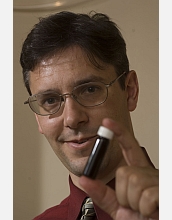
George Huber poses with a vial of green gasoline compounds.

Reporting in the cover article of the April 7, 2008 issue of Chemistry & Sustainability, Energy & Materials (ChemSusChem), chemical engineer and National Science Foundation (NSF) CAREER awardee George Huber of the University of Massachusetts-Amherst (UMass) and his graduate students Torren Carlson and Tushar Vispute announced the first direct conversion of plant cellulose into gasoline components.

In the same issue, James Dumesic and colleagues from the University of Wisconsin-Madison announce an integrated process for creating chemical components of jet fuel using a green gasoline approach. While Dumesic's group had previously demonstrated the production of jet-fuel components using separate steps, their current work shows that the steps can be integrated and run sequentially, without complex separation and purification processes between reactors.

While it may be five to 10 years before green gasoline arrives at the pump or finds its way into a fighter jet, these breakthroughs have bypassed significant hurdles to bringing green gasoline biofuels to market.

"It is likely that the future consumer will not even know that they are putting biofuels into their car," said Huber. "Biofuels in the future will most likely be similar in chemical composition to gasoline and diesel fuel used today. The challenge for chemical engineers is to efficiently produce liquid fuels from biomass while fitting into the existing infrastructure today."

For their new approach, the UMass researchers rapidly heated cellulose in the presence of solid catalysts, materials that speed up reactions without sacrificing themselves in the process. They then rapidly cooled the products to create a liquid that contains many of the compounds found in gasoline.

The entire process was completed in under two minutes using relatively moderate amounts of heat. The compounds that formed in that single step, like naphthalene and toluene, make up one fourth of the suite of chemicals found in gasoline. The liquid can be further treated to form the remaining fuel components or can be used "as is" for a high octane gasoline blend.

"Green gasoline is an attractive alternative to bioethanol since it can be used in existing engines and does not incur the 30 percent gas mileage penalty of ethanol-based flex fuel," said John Regalbuto, who directs the Catalysis and Biocatalysis Program at NSF and supported this research.

"In theory it requires much less energy to make than ethanol, giving it a smaller carbon footprint and making it cheaper to produce," Regalbuto said. "Making it from cellulose sources such as switchgrass or poplar trees grown as energy crops, or forest or agricultural residues such as wood chips or corn stover, solves the lifecycle greenhouse gas problem that has recently surfaced with corn ethanol and soy biodiesel."

Beyond academic laboratories, both small businesses and Fortune 500 petroleum refiners are pursuing green gasoline. Companies are designing ways to hybridize their existing refineries to enable petroleum products including fuels, textiles, and plastics to be made from either crude oil or biomass and the military community has shown strong interest in making jet fuel and diesel from the same sources.

"Huber's new process for the direct conversion of cellulose to gasoline aromatics is at the leading edge of the new ‘Green Gasoline' alternate energy paradigm that NSF, along with other federal agencies, is helping to promote," states Regalbuto.

Not only is the method a compact way to treat a great deal of biomass in a short time, Regalbuto emphasized that the process, in principle, does not require any external energy. "In fact, from the extra heat that will be released, you can generate electricity in addition to the biofuel," he said. "There will not be just a small carbon footprint for the process; by recovering heat and generating electricity, there won't be any footprint."

The latest pathways to produce green gasoline, green diesel and green jet fuel are found in a report sponsored by NSF, the Department of Energy and the American Chemical Society entitled "Breaking the Chemical and Engineering Barriers to Lignocellulosic Biofuels: Next Generation Hydrocarbon Biorefineries". In the report, Huber and a host of leaders from academia, industry and government present a plan for making green gasoline a practical solution for the impending fuel crisis.

"We are currently working on understanding the chemistry of this process and designing new catalysts and reactors for this single step technique. This fundamental chemical understanding will allow us to design more efficient processes that will accelerate the commercialization of green gasoline," Huber said.

Car Sharing

Thursday, February 5, 2009
The primacy of car-based mobility has become a widespread problem in most cities in the world. In Australia, the situation is no different, as the car has an even more dominant role than in European cities. In most of the countries, transport is the fastest growing sector contributing to greenhouse gas emissions. Emissions from transport are second in magnitude only to the stationary energy sector. Enormous amounts of land and capital are bound up with cars, roads and parking space. This is a result of high levels of private car ownership. Although in medium and high-density urban areas many people walk, cycle and use public transport, there are occasions when they still see a need for some car travel. This is the 'mobility gap' that car sharing seeks to all.


This report describes the concept of car sharing. Its purpose is to identify car sharing organisations in other countries and to examine the preconditions required to establish and run a car sharing organisation (CSO) in order to examine the countries conditions as a basis on which to encourage local initiatives. At an anecdotal level, car sharing is known to exist in a number of cities. For example, approval was granted to a high-rise residential development to operate a car sharing scheme through a local car provider as a substitute for not providing on-site car parking. Other CSOs are small-scale and none is known to be linked formally to public transport providers.

Car sharing is one of a number of mobility strategies, which solves some car ownership problems and problems associated with high car-reliance.

In the primary layer, individuals gain the benefits of private cars without the costs and responsibilities of ownership. Specifically, car sharing allows a member (such as a household or business) to access a meet of shared cars and other types of motor vehicles as needed, paying a usage fee each time. This removes high fixed costs such as registration and third-party insurance, as most costs become both variable and lower. Vehicles are available to members more or less as required for any length of time (from one hour, up to several weeks or more) and at many points (dozens of locations in a city or even in other cities). So, instead of buying a car, people and/or companies, share a meet of vehicles with usage costs dependent on the kilometres travelled and the period of time for which the vehicle is booked. In the second layer, car sharing helps the community reduce the number of trips and distances travelled by private cars. In the third layer, urban communities gain space for productive uses when space currently occupied by roads and parking is not expanded and communities also experience less air and noise pollution.


Car sharing should not be confused with car pooling, which is more accurately termed 'ride-sharing'. In car pooling, owners of cars provide rides to other passengers in a more or less organised way, on a regular or irregular basis. It requires mutual agreement and trust and is generally not suitable for organising as a for-profit business.

The opportunity remains, however, to systematically develop appropriate indicators and an agreed methodology to compare different car sharing schemes.

Some potential indicators include:

  • number of vehicles/members (total members)
  • reduction in private motor vehicle kilometres travelled (VKT)
  • CO2 emissions reduced
  • number of cars replaced
  • increase in public transport use
  • increased time walking and cycling
  • area/kerbside distance of parking saved with opportunity for improved re-use, e.g. as dedicated cycleway, parkland and/or open space
  • more affordable housing or other savings in developments, e.g. saving space and costs of parking and improving amenity.
Benefits to individuals involved in car sharing :

The following are some of the key reasons individuals may choose to be involved in a car sharing organisation:

  • Economic : significant reduction of costs as opposed to owning a motor vehicle, including no need for private parking space and the opportunity to redeploy household expenditure that would typically have been devoted to the sunk costs associated with motor vehicle ownership.
  • Convenience : no administrative effort or time expenditure on insurance, purchase and sale, repairs, permits etc.
  • Improved access: enhanced mobility options, including access to multiple types of vehicle resulting in a choice of the most economically sensible transport mode.


CAFE

Tuesday, February 3, 2009
Corporate Average Fuel Economy (CAFE) is the sales weighted average fuel economy, expressed in miles per gallon (mpg), of a manufacturer's fleet of passenger cars or light trucks with a gross vehicle weight rating (GVWR) of 8,500 lbs. or less, manufactured for sale in the United States, for any given model year. Fuel economy is defined as the average mileage traveled by an automobile per gallon of gasoline (or equivalent amount of other fuel) consumed as measured in accordance with the testing and evaluation protocol set forth by the Environmental Protection Agency (EPA).

The Secretary of Transportation has delegated authority to establish CAFE standards to the Administrator of the National Highway Traffic Safety Administration (NHTSA). NHTSA is responsible for establishing and amending the CAFE standards; promulgating regulations concerning CAFE procedures, definitions and reports; considering petitions for exemption from standards for low volume manufacturers and establishing unique standards for them; enforcing fuel economy standards and regulations; responding to petitions concerning domestic production by foreign manufacturers and all other aspects of CAFE, including the classification of vehicle lines as either cars or trucks; collecting, recording and cataloging Pre- and Mid-model year reports; adjudicating carry back credit plans; and providing program incentives such as credits for alternative fueled vehicle lines.

EPA is responsible for calculating the average fuel economy for each manufacturer. CAFE certification is done either one of two ways:

1) The manufacturer provides its own fuel economy test data,
2) the EPA will obtain a vehicle and test it in its Office of Transportation & Air Quality facility in Ann Arbor, MI.

EPA will do actual tests on typically about 30% of the existing vehicle lines, using the same laboratory test that they use to measure exhaust emissions. The entire certification test procedure, including the vehicle test preparation, the actual running of the test on the dynamometer, the recording of the data, etc.

Congress specified that CAFE standards must be set at the "maximum feasible level". Congress provided that the Department's determinations of maximum feasible level be made in consideration of four factors:

(1) Technological feasibility;
(2) Economic practicability;
(3) Effect of other standards on fuel economy; and
(4) Need of the nation to conserve energy

Manufacturers can earn CAFE "credits" to offset deficiencies in their CAFE performances. Specifically, when the average fuel economy of either the passenger car or light truck fleet for a particular model year exceeds the established standard, the manufacturer earns credits. The amount of credit a manufacturer earns is determined by multiplying the tenths of a mile per gallon that the manufacturer exceeded the CAFE standard in that model year by the amount of vehicles they manufactured in that model year. These credits can be applied to any three consecutive model years immediately prior to or subsequent to the model year in which the credits are earned. The credits earned and applied to the model years prior to the model year for which the credits are earned are termed "carry back" credits, while those applied to model years subsequent to the model year in which the credits are earned are known as "carry forward" credits. Failure to exercise carry forward credits within the three years immediately following the year in which they are earned will result in the forfeiture of those credits. Credits cannot be passed between manufacturers or between fleets, e.g., from domestic passenger cars to light trucks.

Authority to establish vehicle classifications for the purposes of calculating CAFE was delegated to NHTSA. Specifically, the definitions are as follows:

1. Passenger Car – any 4-wheel vehicle not designed for off-road use that is manufactured primarily for use in transporting 10 people or less.

2. Truck – A vehicle can be classified as a truck if it meets one of the following criteria:
  • It is 4-wheel drive or it is rated at 6,000 pounds gross vehicle weight AND has at least four of the following characteristics:
  1. Approach angle of not less than 28 degrees
  2. Breakover angle of not less than 14 degrees
  3. Departure angle of not less than 20 degrees
  4. Running clearance of not less than 20 centimeters
  5. Front and read axle clearances of not less than 18 centimeters each
  • It can perform at least one of the following functions:
  1. Transport more than 10 people;
  2. Provide temporary living quarters;
  3. Transport property in an open bed;
  4. Permit greater cargo-carrying capacity than passenger-carrying volume;
  5. Can be converted to an open bed vehicle by removal of rear seats to form a flat continuous floor with the use of simple tools.

4 Steps to Protect Children

Tuesday, January 27, 2009
Securing our Most Precious Cargo
Motor vehicle crashes are the leading cause of death among children ages 2 to 14, due in large part to the nonuse or improper use of child seats and seat belts. Working with parents and our partners our goal is to ensure every child is properly secured and safe every trip, every time.


Parents - Not Sure Which Car Seat to Use?
Are you looking for a new car seat for your infant, toddler or 4-8 year old child but overwhelmed by the choices and worried about how to properly install your car seat? Our 4 Steps for Kids campaign will help you properly choose and install the correct car seat for your child. Simply click on the link below that best matches your child.

REAR-FACING SEATS

Infants - from birth to at least 1 year old
For the best possible protection keep babies in the back seat, in rear-facing child safety seats, as long as possible up to the height or weight limit of the particular seat. At a minimum, keep babies rear-facing until a minimum of age 1 and at least 20 pounds.

FORWARD-FACING TODDLER SEATS

Toddlers - Age 1 & 20 lbs to Age 4 & 40 lbs
When children outgrow their rear-facing seats (at a minimum age 1 and at least 20 pounds) they should ride in a forward-facing toddler seat, in the back seat, until they reach the upper weight or height limit of the particular seat (usually around age 4 and 40 pounds).

BOOSTER SEATS

Children - from about age 4 to at least age 8
Once children outgrow their forward-facing seat (usually around age 4 and 40 pounds), they should ride in booster seats, in the back seat, until the vehicle seat belts fit properly. Seat belts fit properly when the lap belt lays across the upper thighs and the shoulder belt fits across the chest (usually at age 8 or when they are 4'9” tall).

SAFETY BELTS

Tweens - age 8 and older
When children outgrow their booster seats, (usually at age 8 or when they are 4'9” tall) they can use the adult seat belt in the back seat, if it fits properly (lap belt lays across the upper thighs and the shoulder belt across the chest).


Car Vehicle Parts Copyright © 2011-2012 | Powered by Blogger